
AI Voicebot in the Philippines: What It Is and How It Works
AI Voicebot in the Philippines: What It Is and How It Works
Call a company in the Philippines today and there's a fair chance the first voice you hear isn't a person. An AI voicebot can answer the phone, understand what you're asking, look up your account, and respond in a natural-sounding voice, all within seconds and at any hour. For a country built on customer service and BPO, that's a big shift, and it raises fair questions. How does it actually work? Does it really sound human? And when should a real person step in?
This guide explains it in plain terms: the technology behind an AI voice bot, what "sounds like a human" means in practice, where bots still fall short, and how to decide when a call should be handed to a live agent.
What Is an AI Voicebot?
An AI voicebot is software that holds spoken conversations with callers. Instead of asking you to press 1 for billing or 2 for support, it lets you simply say what you need, and it responds out loud.
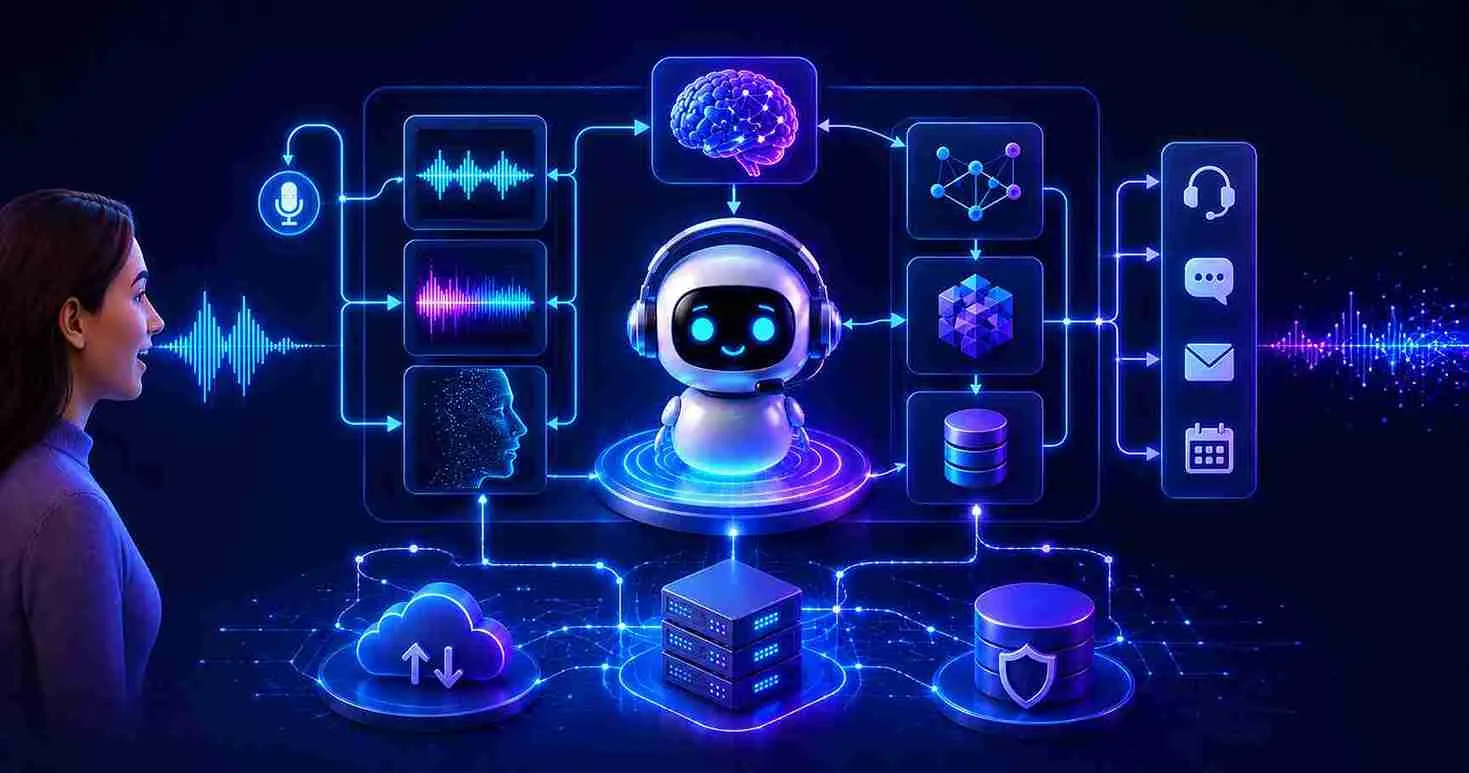
Behind the scenes, an artificial intelligence voicebot combines several technologies: it listens to speech, works out what the caller wants, decides what to do next, and speaks the answer back. Many also connect to business systems, such as a CRM, booking calendar, or order database, so they can do real work and not just answer FAQs.
AI Voicebot vs. Traditional IVR
Older phone menus (IVR) and modern automated voicebots are often confused, but they behave very differently:
- Traditional IVR: follows a fixed menu tree, expects keypad presses or exact keywords, and breaks down when callers say something unexpected
- AI voicebot: understands natural sentences, handles interruptions and rephrasing, and can manage a conversation that doesn't follow a script
- The practical difference: an IVR makes the caller adapt to the system, while a voicebot adapts to the caller
How an AI Voicebot Works, Step by Step
Every voicebot call moves through the same basic loop, usually in under a couple of seconds per turn.
Step 1: Speech Recognition (Turning Voice Into Text)
Automatic speech recognition (ASR) converts the caller's audio into text. This is the first place things can go wrong. Phone audio is compressed, and background noise, accents, and fast speech all make transcription harder. Good systems are trained on large amounts of real call audio, including the accents and speaking patterns of their target market.
Step 2: Natural Language Understanding (Working Out What the Caller Means)
Once the words are transcribed, natural language understanding (NLU) figures out the caller's intent and pulls out key details. If someone says, "Hi, I want to move my appointment from Friday to next Tuesday," the system identifies the intent (reschedule) and the details (current date, new date).
Modern systems often use large language models for this step, which makes them far better at handling messy, conversational phrasing than the keyword-matching systems of the past.
Step 3: Dialogue Management and Business Logic (Deciding What to Do)
This is the "brain" in the middle. It decides the next action: ask a clarifying question, look up an order, update a booking, verify the caller's identity, or pass the call to a human. Well-designed bots use clear rules for sensitive actions, such as payments, even when the language model handles the conversation.
Step 4: Text-to-Speech (Turning the Answer Back Into Voice)
Text-to-speech (TTS) converts the bot's reply into audio. Older TTS sounded flat and robotic. Newer neural voices have natural rhythm, intonation, and pauses, which is the main reason an AI voicebot in Philippines like a human is now realistic and not just a marketing line.
Why Speed Matters
People notice delays quickly. If a bot takes too long between the caller finishing and the bot responding, the conversation feels awkward and callers talk over it. Fast, low-latency response is a major part of what makes a voice experience feel natural.
Why AI Voicebots Matter in the Philippines
The Philippines is one of the world's largest customer service and outsourcing hubs, so voice automation is closely tied to how local businesses and BPOs operate.
- Round-the-clock coverage: a voicebot can answer calls overnight and on holidays without a graveyard shift
- Handling call spikes: during promos, billing cycles, or typhoon-related disruptions, bots can absorb sudden surges that would overwhelm a small team
- Routine call deflection: simple, repetitive calls (order status, balances, appointment changes, store hours) can be automated so human agents focus on complex or sensitive cases
- Consistency: a bot gives the same accurate answer every time and doesn't have off days
The Language Challenge: Taglish and Beyond
Language is where the Philippine market is genuinely different. Callers often switch between English and Filipino in the same sentence (Taglish), and many also speak regional languages such as Cebuano or Ilocano. A voicebot built mainly on a standard American English model can stumble on:
- Mixed-language sentences
- Local place names, brand names, and surnames
- Regional accents and fast, casual speech
- Polite particles and phrasing that carry meaning in Filipino
When evaluating any automated voicebot for the Philippines, testing it with real local callers matters far more than a polished demo.
What "Sounds Like a Human" Actually Means
Vendors love to say their bot sounds human. In practice, that claim covers several separate qualities, and it's worth knowing which ones you're getting.
- Natural voice quality: smooth tone, believable intonation, and proper pacing instead of a robotic monotone
- Natural turn-taking: the ability to be interrupted (often called barge-in) and to respond without long awkward pauses
- Conversational understanding: handling "um," corrections, and side comments without losing the thread
- Appropriate tone: sounding polite and warm in Filipino service culture, where courtesy matters a lot
- Language flexibility: moving between English and Filipino the way callers actually speak
What it does not mean is that the bot should pretend to be a person. Being upfront that the caller is speaking with an automated assistant is good practice for trust, and in some cases may be expected by regulators or your own policies. A voice can be pleasant and natural without being deceptive.
Where AI Voicebots Still Fall Short
Voicebots have improved quickly, but they aren't perfect, and honest expectations lead to better results.
- Noisy lines and poor audio: background noise or weak mobile signal can reduce recognition accuracy
- Heavy accents and code-switching: accuracy can drop if the system wasn't trained on similar speech
- Emotional situations: an upset or grieving caller often needs empathy a bot can't genuinely provide
- Complex or unusual problems: cases with many exceptions, or issues the bot has never seen, can confuse it
- Ambiguity: names, numbers, and addresses are easy to mishear and need confirmation steps
- Confident mistakes: language-model-based systems can sometimes give a fluent but wrong answer if they aren't properly constrained to verified information
When to Hand Off to a Live Agent
A good voicebot knows its limits. Smooth handoff to a human is one of the most important design decisions in any deployment.
Common triggers for handing off include:
- The caller asks for a human, even once
- The bot fails to understand the caller after two or three attempts
- The caller sounds frustrated, angry, or distressed
- The issue involves a complaint, dispute, or sensitive account change
- High-value or high-risk situations, such as large payments or cancellations of major accounts
- Anything involving safety, health, or legal matters
Handoff works best when the human agent receives the conversation context, including the caller's details and what's already been discussed, so the customer doesn't have to repeat themselves.
Common Uses for Automated Voicebots
- Customer support: order tracking, account questions, and FAQs
- Appointment management: booking, rescheduling, and reminders for clinics, salons, and service providers
- Collections and payment reminders: polite, consistent follow-up calls
- Lead qualification: asking a few screening questions before passing promising leads to sales
- Surveys and feedback: quick post-call or post-purchase calls at scale
- After-hours answering: capturing messages and handling basic needs when the office is closed
Privacy, Consent, and Compliance in the Philippines
Voice calls contain personal information, so privacy needs to be part of the plan from the start. Businesses in the Philippines should keep these points in mind and confirm specifics with legal counsel:
- The Data Privacy Act of 2012 (Republic Act 10173) governs how personal data is collected, used, stored, and shared, and callers have rights over their information
- Call recording should follow clear consent practices, and Philippine law restricts recording private communications without proper consent
- Disclosure that the caller is speaking with an automated system builds trust and reduces risk
- Data storage and vendors: know where voice data and transcripts are stored and who has access
- Sensitive actions: apply identity verification before sharing account details or processing changes
How to Evaluate an AI Voicebot Before You Commit
If you're considering one for your business, use a checklist rather than a demo alone:
- Test it with real calls from your actual customers, including different accents and Taglish
- Measure how quickly it responds and how well it handles interruptions
- Check how it behaves when it doesn't know the answer
- Review how and when it hands off to a human agent
- Confirm it connects to the systems you already use
- Ask about data security, storage, and compliance
- Start with a small, well-defined use case and expand once it performs well
Frequently Asked Questions About AI Voicebots in the Philippines
What is an AI voicebot?
An AI voicebot is software that talks with callers using speech recognition, language understanding, and a synthetic voice. It can answer questions, complete tasks, and route calls without a human on the line.
How is an AI voice bot different from a chatbot?
A chatbot works through typed text, while a voicebot handles spoken conversation. Voicebots need extra technology for speech recognition and speech generation, and have to deal with real-time factors like interruptions, accents, and phone-line quality.
Can an AI voicebot sound like a real person?
Today's neural voices can sound very natural, with realistic tone and pacing. Still, the best practice is to be transparent that callers are speaking with an automated assistant, and to hand off to a human when the situation calls for it.
Can AI voicebots understand Taglish and Filipino accents?
Some can, but performance varies widely. Systems trained on Filipino and mixed-language speech tend to do better than those built mainly for standard English. Testing with real local callers is the only reliable way to know.
Will an AI voicebot replace human call center agents?
Not entirely. Voicebots are best at routine, repetitive calls, which frees human agents for complex, emotional, or high-value conversations. Most successful setups combine both.
Is it legal to use an AI voicebot in the Philippines?
Using one is generally permitted, but you need to follow privacy and recording rules, including the Data Privacy Act. Requirements depend on your industry and use case, so check with a qualified legal professional.
What kinds of businesses benefit most from voicebots?
Businesses with high call volumes or repetitive questions tend to benefit most, such as BPOs, telecoms, banks, insurers, healthcare providers, retailers, and delivery or logistics companies.
The Bottom Line
An AI voicebot is a practical way to answer more calls, faster, at any hour, as long as it's matched to the right jobs. The strongest setups are honest about being automated, tested with real Philippine callers, and designed to pass the conversation to a person whenever it matters most.
If you're exploring voice automation alongside your customer support or BPO operations, our team can help you think through the setup.