
What Is an ACD and How Does Call Routing Work?
What Is an ACD and How Does Call Routing Work?
When a customer calls your business, someone has to decide which agent answers. In a small office, a receptionist can do that. In a Philippine BPO or contact center taking thousands of calls a day across several campaigns, that decision has to happen in milliseconds, and it has to be right.
That job belongs to the ACD, or Automatic Call Distributor. This guide explains what an ACD is, how call routing works step by step, the main routing methods, and what to look for when choosing ACD software for your call center in Manila, Taguig, Cebu, Davao, or anywhere else in the Philippines.
What Is an ACD (Automatic Call Distributor)?
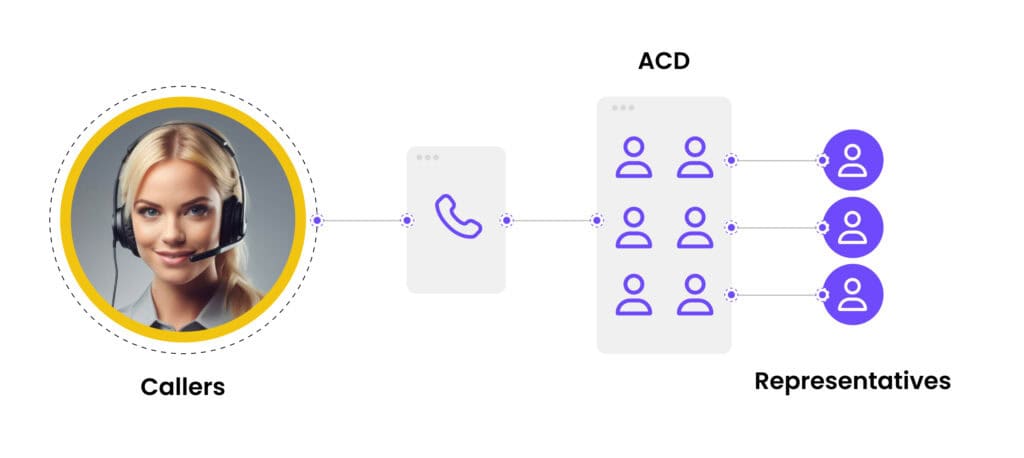
An ACD is the part of your call center software that receives incoming calls and automatically sends each one to the most suitable agent or queue, based on rules you set. It replaces manual call handling with consistent, rules-based routing.
A good ACD does four things:
• Answers and identifies the call, using caller number, dialed number, or IVR input
• Decides where it should go, using skills, priority, language, and agent availability
• Queues the caller if nobody is free, with announcements or callback options
• Records data on every call for reporting and quality assurance
ACD is usually one module inside broader call center software in the Philippines rather than a standalone product. It works alongside the dialer, IVR, softphone, call recording, and CRM.
How Does Call Routing Work? Step by Step
The exact flow depends on your setup, but most ACD-based call routing follows these steps:
1. The call arrives. A customer dials your hotline, which reaches your system through a SIP trunk or VoIP carrier.
2. The system identifies the call. It reads the dialed number (which hotline or campaign) and the caller ID. If the number matches a record in your CRM, the customer can be recognized immediately.
3. The IVR collects input (optional). An Interactive Voice Response menu asks the caller to choose a language, department, or reason for calling, for example "Press 1 for billing, press 2 for technical support." Some callers resolve their issue here without an agent.
4. Routing rules are applied. The ACD checks conditions such as required skill, caller priority, time of day, and queue status.
5. The ACD finds an agent. It looks for an available agent in the right group, using a distribution method such as longest idle or round robin (see below).
6. If no agent is free, the caller is queued. They hear hold messages or music, and may be offered a callback instead of waiting.
7. The call connects. The agent's softphone rings, and the customer record pops up on screen.
8. Everything is logged. Wait time, talk time, disposition, and recordings feed your reports.
Common Types of Call Routing
Different campaigns call for different routing logic. These are the methods most Philippine contact centers use:
Skill-Based Routing
Calls go to agents with the right skills, such as Tagalog, Cebuano, English, or a specific product. This is the most common method in BPOs serving several clients or languages, because it matches the caller to the best-qualified agent rather than just the next free one.
Longest Idle (Uniform) Distribution
The call goes to the agent who has been waiting longest since their last call. It spreads work evenly and keeps agents from feeling overloaded or overlooked.
Round Robin
Calls rotate through agents in a fixed order. It is simple and fair, but it ignores skills and current workload, so it suits teams with uniform duties.
Priority and VIP Routing
High-value or urgent callers are placed ahead in the queue or sent to a dedicated team. Examples include premium accounts, escalations, and time-sensitive collections follow-ups.
Time-Based Routing
Calls are routed differently by hour or day. For instance, daytime calls go to your Manila team, night calls go to another site, and after-hours calls go to voicemail or a callback queue.
Overflow and Fallback Routing
If a queue passes a wait-time or length threshold, calls spill over to another team or site. This protects your service level during spikes and when agents are absent.
Last-Agent (Sticky) Routing
Returning callers are sent to the agent they spoke with before. It helps with complex or relationship-driven accounts, such as lending and collections, where continuity builds trust.
• Skill-based: Best for: Multi-language, multi-campaign BPOs; Watch out for: Needs well-maintained agent skill profiles
• Longest idle: Best for: Fair workload across a uniform team; Watch out for: Ignores agent expertise
• Round robin: Best for: Simple teams with identical duties; Watch out for: Ignores workload and skills
• Priority / VIP: Best for: Premium accounts and escalations; Watch out for: Can lengthen waits for standard callers
• Time-based: Best for: Multi-site and follow-the-sun setups; Watch out for: Rules must be updated for holidays
• Overflow: Best for: Peak periods and absences; Watch out for: Overflow teams need the right training
• Last-agent: Best for: Relationship and collections accounts; Watch out for: Fails if that agent is offline
ACD vs IVR: What's the Difference?
The two are often confused, but they work as a pair:
• IVR is the automated menu and self-service layer. It collects information from the caller.
• ACD is the routing and queueing engine. It uses that information, plus agent data, to decide where the call goes.
In practice, the IVR gathers what the caller needs and the ACD delivers them to the right person. Strong results come from designing both together.
ACD for Inbound, Outbound, and Blended Centers
ACD is most associated with inbound calls such as customer support, hotlines, and service desks. But it also matters for outbound and blended operations:
• Inbound centers rely on ACD for queues, routing, and service levels.
• Outbound centers that use a predictive dialer in the Philippines often take callbacks from customers who return a missed call. The ACD routes those callbacks to the right campaign team.
• Blended centers let the system move agents between inbound and outbound work depending on queue load, so agents are rarely idle.
Benefits of Using ACD Software
• Shorter wait times and fewer transfers, because callers reach the right agent first
• Higher first-call resolution, because skilled agents handle the right issues
• Better agent utilization, because work is distributed fairly and automatically
• Consistent service levels during peak periods through queue and overflow rules
• Reliable data on call volumes, wait times, and abandonment for staffing decisions
• Easier scaling, since new campaigns or agents are added by changing rules, not rebuilding the setup
Key Metrics to Track
Your ACD reports should make these easy to monitor:
• Service level: The share of calls answered within your target time (for example, within 20 seconds)
• Average speed of answer (ASA): How long callers wait on average before an agent picks up
• Abandonment rate: The percentage of callers who hang up before reaching an agent
• Average handle time (AHT): Talk time plus after-call work per call
• Occupancy: How much of an agent's logged-in time is spent handling calls
• Queue length and longest wait: Real-time signals that you need to add agents or adjust routing
What to Look for in ACD Software
When comparing ACD solutions, ask vendors about:
1. Routing flexibility. Can you combine skill, priority, and time-based rules without custom development?
2. IVR integration. Is the menu builder part of the platform, and can IVR choices drive routing?
3. Real-time dashboards. Can supervisors see queues and agent status live, and listen, whisper, or barge into calls?
4. CRM integration. Does the agent see customer data the moment a call connects?
5. Call recording. Is a voice logger with dialer built in, with recordings tied to each call record?
6. Omnichannel support. Can the same routing logic handle SMS, chat, and email, not just voice?
7. Deployment options. Is it available as cloud-based call center solutions or on-premise, to match your security and budget needs?
8. Local support and fast setup. Is the provider reachable in Philippine business hours, and how quickly can you go live?
ACD Solutions in Manila with Lgorithm Solutions
Lgorithm Solutions provides ACD as part of a complete contact center platform that also includes a predictive dialer, voice and screen logger, inbuilt softphone, SMS/voice blaster, and reporting and WFM tools. You can deploy on-premise or in the cloud, and rent, buy, or rent-to-own depending on your budget.
Whether you run a small inbound hotline or a multi-campaign BPO, we can design routing rules around your queues, languages, and service-level targets. Contact us for an ACD demo and see call routing running on your own scenario.
Frequently Asked Questions
What does ACD stand for in a call center?
ACD stands for Automatic Call Distributor. It is the system that receives incoming calls and routes each one to an available, suitable agent or queue based on set rules.
What is the difference between ACD and IVR?
An IVR is the automated menu that collects information from callers. An ACD uses that information, plus agent skills and availability, to route the call. Most call centers use both together.
What is skill-based routing?
Skill-based routing sends a call to an agent with the specific skills needed, such as language, product knowledge, or seniority, instead of simply choosing the next free agent.
Do outbound call centers need an ACD?
Most do, at least for callbacks. Customers often return missed calls, and an ACD routes those calls to the right campaign team. Blended centers also use ACD to balance inbound and outbound work.
Can ACD software run in the cloud?
Yes. Many providers offer cloud-based ACD, which is faster to deploy and easier to scale. On-premise options remain available for operations needing full infrastructure control.
Conclusion
An ACD is the traffic controller of your call center. By identifying each caller, applying smart routing rules, and managing queues, it gets customers to the right agent faster and gives you the data to keep improving.
Choose software that offers flexible routing, IVR integration, real-time monitoring, CRM and recording integration, and deployment options that fit your business. Ready to improve how your calls are handled? Request a free demo from Lgorithm Solutions.